What Is This Bump?
Eight common skin growths I see all the time, which ones can be left alone, and when to get a bump checked.
As a dermatologist and Mohs surgeon, a lot of my day is spent looking at bumps people are worried about.
The good news: most lumps and bumps on the skin are completely benign. Many don’t need treatment at all. The catch is that a few harmless growths can look like skin cancer, and a few can’t be fixed at home no matter how tempting it is.
Here are eight I see all the time.
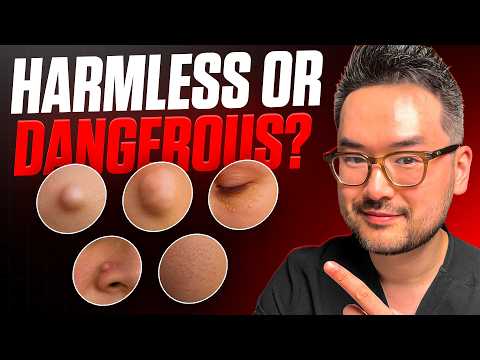
1. Epidermoid and pilar cysts
A cyst is a small sac under the skin filled with keratin, the protein your skin is made of. Epidermoid cysts often have a tiny dark opening in the centre. Pilar cysts are firm, smooth, and usually on the scalp, and they tend to run in families.
Here’s what most people don’t know: draining a cyst doesn’t remove it. The sac stays behind and refills. The only permanent fix is removing the whole sac, ideally when it isn’t inflamed.
2. Lipomas
A lipoma is a soft, rubbery lump of fat cells that moves slightly under your fingers. They grow slowly and are almost always harmless. They’re removed if they bother you.
A lump that’s growing quickly, feels hard or fixed in place, or is painful should be examined.
3. Syringomas
These are small, skin-coloured or yellowish bumps, usually under the eyes, that come from sweat ducts. They’re harmless. They can be treated, but they sit close to the surface of delicate skin, so treatment needs to be gentle to avoid scarring.
4. Angiofibromas
Small, firm, pink or skin-coloured bumps, often on the nose. A single one in an adult is common and harmless. Many of them appearing on the face in childhood is worth a medical assessment.
5. Keratosis pilaris
Those rough little bumps on the upper arms, thighs, or cheeks. They’re plugs of keratin around hair follicles, and they’re extremely common.
The instinct is to scrub them away. Don’t. Aggressive scrubbing irritates the skin and usually makes it look worse. A moisturizer with gentle exfoliating ingredients like urea or lactic acid, used consistently, works much better.
6. Pyogenic granulomas
A red, shiny bump that appears quickly, often after a small injury, and bleeds at the slightest touch. Despite the name, it isn’t an infection.
These are benign, but I always want to see them. They usually need removal, and a fast-growing bump that bleeds easily is exactly the kind of spot that should be properly assessed, because some skin cancers can look similar.
7. Mucoceles
A soft, bluish, fluid-filled bubble, usually on the inside of the lower lip. They come from a small salivary gland that’s been damaged, often from lip biting. Some settle on their own; ones that keep coming back can be removed.
8. Digital myxoid cysts
A small, shiny bump near the last joint of a finger, close to the nail. Sometimes it causes a groove in the nail. They’re linked to wear and tear in the joint underneath.
Please don’t poke these with a needle. Because they sit so close to the joint, there’s a risk of infection.
Why you shouldn’t treat bumps at home
Cutting, squeezing, or draining a lump at home risks infection and scarring. It also usually doesn’t work, because the part that causes the bump is still there. And if the bump isn’t what you think it is, you’ve delayed a proper diagnosis.
When to get a bump checked
Most bumps are harmless, but have it looked at if it:
- Is new and growing quickly
- Bleeds easily or doesn’t heal
- Is hard, fixed in place, or painful
- Looks different from your other spots
- Is changing in size, shape, or colour
If you’re not sure, that’s reason enough. You can read more about skin cancer checks and moles on my site.
What I’d do
Don’t panic about every bump, and don’t operate on yourself either. Most of these are harmless and many can be left alone. But a spot that’s new, changing, or bleeding deserves a look from a doctor.
This article is for general education and is not personal medical advice. Every person and every skin is different, and results vary; for a concern about your own skin, see a doctor.
Also on Substack: read this article on Dr. Guo’s Substack
Free skincare guide: your routine, age by age
Get the guide